What I Talk About When I Talk About Grading

“I’m supposed to graduate summa cum laude so I need an A in this class.”

That sentence, repeated to me at the end of most sessions of a 2-credit elective, was one of the strangest student interactions I ever had, made stranger by the use of “supposed to.” I took it as the obsessive noting of an expected outcome, if only I wouldn’t get in the way and screw it up.

My usual responses to the student, such as: ‘So, that means you’ll work really hard in this class, right?” only received a blank stare. My prodding of what interested her in the subject matter were similarly blank.

And yet, at the end of almost every class, that “supposed to” returned.

“Re-Centering” Academics

The last several generations saw tremendous changes in the expectations of university education. 

We went from academic admissions exams to an appeal for well-rounded students, from the introduction of aptitude tests to the test prep industry and the normalization of test retakes, from the blanket availability of student loans to dramatic tuition increases, from college attendance being the exception to the expectation, from mostly men to mostly women attending college. 

Access to the subject matter changed as well. While advanced content was formerly locked away in specialized books only available in university libraries and in the heads of professors, today you don’t need to join an institution. An explosion of online courses, YouTube channels, niche newsletters, and now AI, means that interested students have education at their fingertips in just about any subject. Many of those library books I wished I had access to growing up are digitized, sometimes free, or available to search and purchase. 

But what those books and online content don’t do – or don’t do very well – is provide a trusted evaluation of performance – a grade. 

Many recent articles and faculty have been debating what grades actually mean anymore. So I read the recent report Re-Centering Academics at Harvard College: Update on Grading and Workload

As we discuss grading, let me call out some sections of that report. Continue reading “What I Talk About When I Talk About Grading”
Responsibility Clawbacks (McKinsey and Purdue Pharma)

In recent weeks consulting firm McKinsey has been back in the news because of the advice it gave its client Purdue Pharma, makers of OxyContin. The advice blatantly looks like increasing drug sales at the expense of patient health and a worsening opioid epidemic. As a result, McKinsey has been fined $573 million.

But even if the Purdue Pharma-related fine is extreme, the example is just one example of McKinsey’s many bad client outcomes. A short list of other bad outcomes or questionable clients include:

  • Advising badly-run government coronavirus responses.
  • Advising financial firms to increase their debt load in the lead up to the 2008 financial crisis.
  • Advising Enron in the lead-up to its financial scandal.
  • Advising Riker’s Island jail on ways to improve safety with the outcome a more dangerous situation.
  • Advising authoritarian governments including Saudi Arabia, Russia, and China.

Continue reading “Responsibility Clawbacks (McKinsey and Purdue Pharma)”

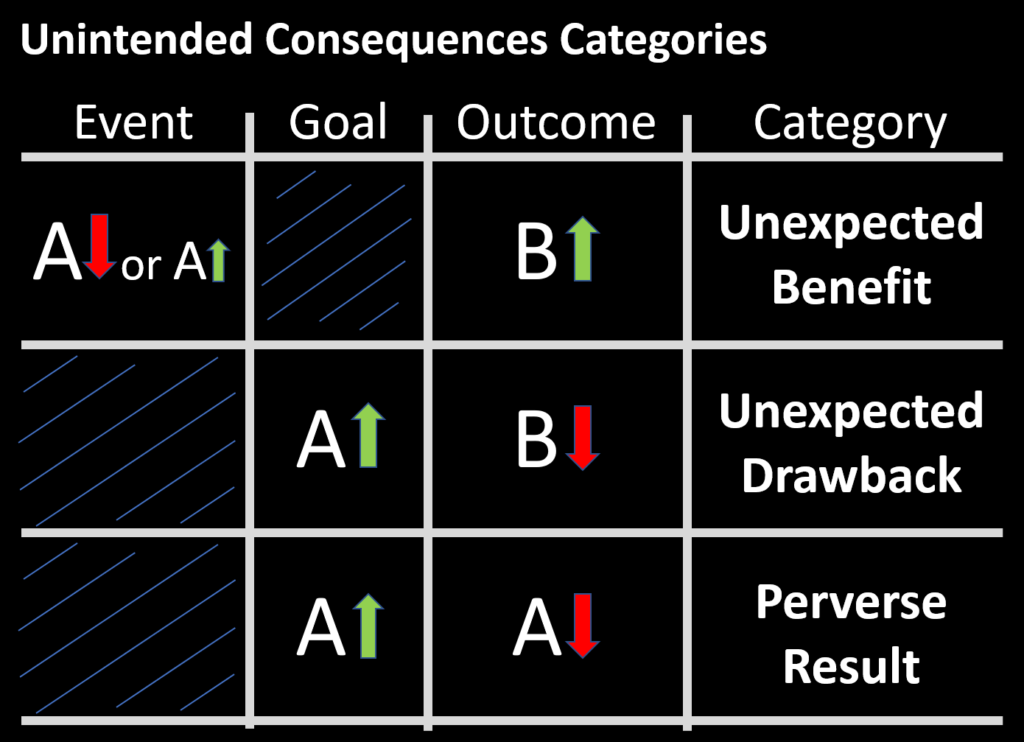
Categories of Unintended Consequences


There are many frameworks with which to evaluate unintended consequences. So far in my writing here I’ve looked at examples arranged around a theme (species introduction, food, government policy, human behavior etc) where there is a somewhat clear relationship between cause and effect (even if sometimes only in hindsight). I haven’t yet touched frameworks of complexity and won’t do so until I go deeper into more second-order effects.

This week I step back and look at basic categories of unintended consequences and call out potential new areas of exposure to second-order effects.

Unintended Consequences Categories
General categories of unintended consequences

Continue reading “Categories of Unintended Consequences”

What Are Unexpected Benefits?

When studying unintended consequences and second-level thinking, the least common category of example is the unexpected benefit. This is a positive, yet unexpected or unpredictable outcome from an action.

Compare against the unexpected drawback (unexpected detriments that occur in addition to the desired effect of the solution) and the perverse result (the “solution” makes the problem worse).

And a scan of common examples makes me believe that some of what we call unexpected benefits are improperly classified.

Continue reading “What Are Unexpected Benefits?”

Get new posts by email Occasional deep dives. No spam.